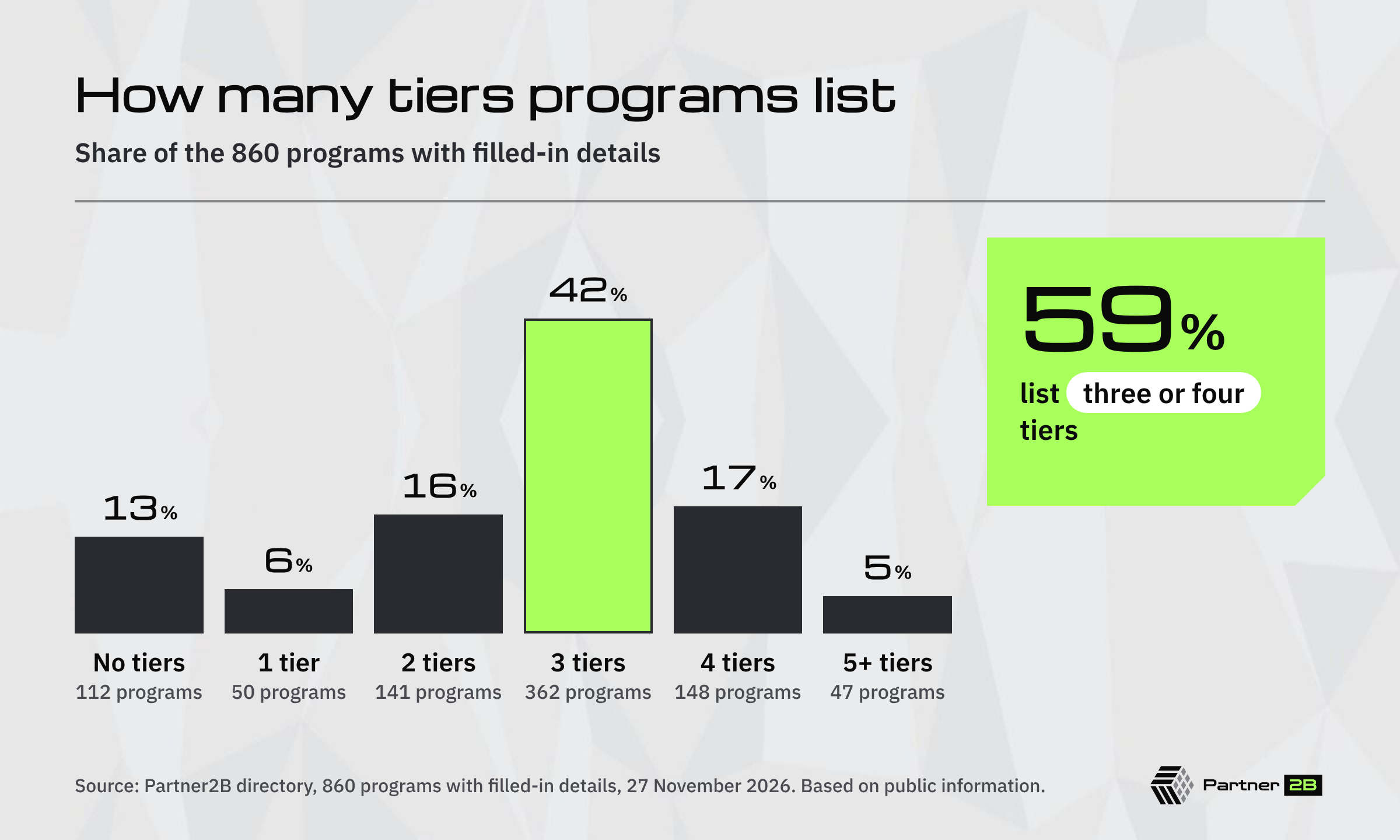
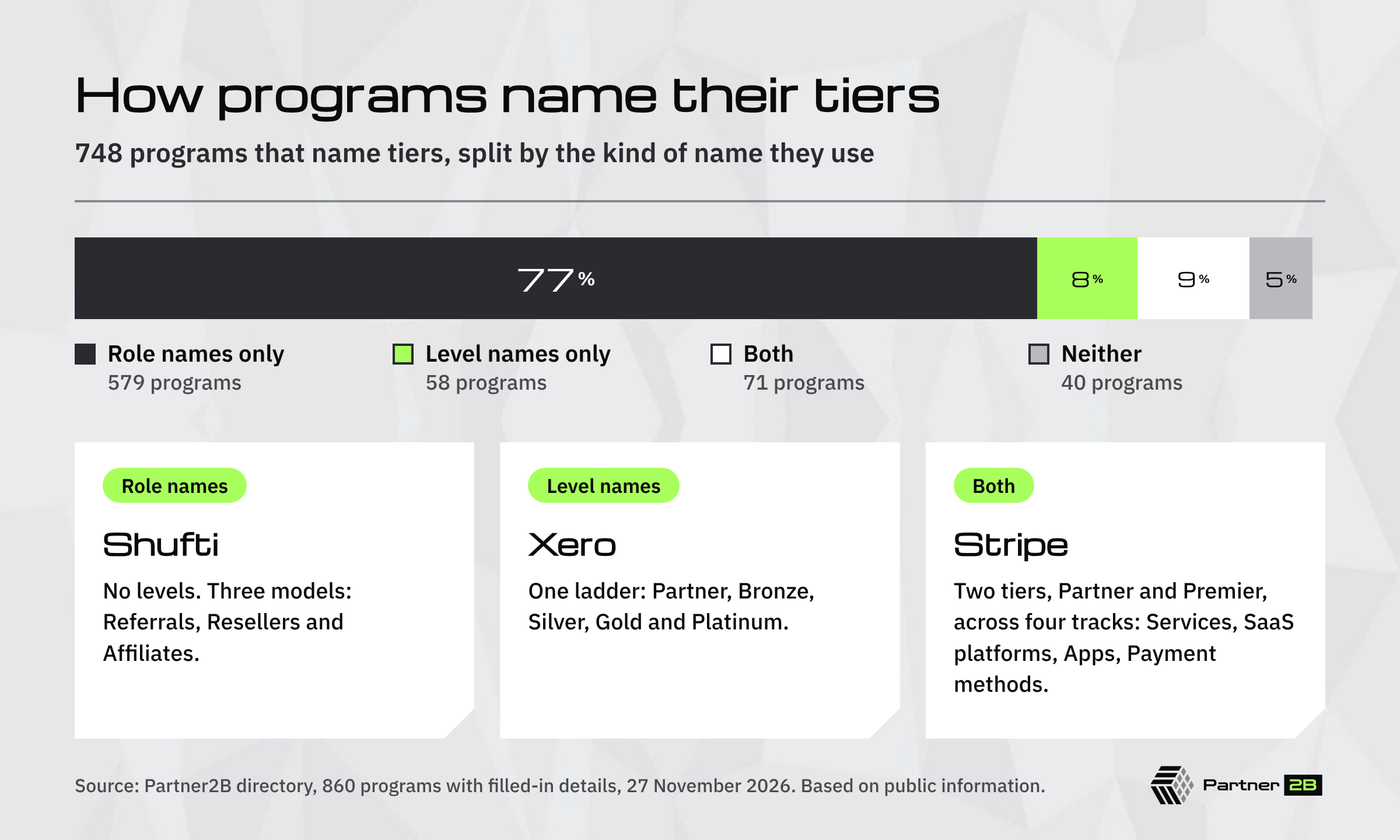
Three tiers is the most common setup: 42% of the 860 partner programs we compared list three, and 59% list three or four. Most programs sort partners by role (Technology, Referral, Reseller), not by level (Silver, Gold, Platinum). Of the programs that name tiers, 77% use role names only and 8% use level names only. Programs with level names publish their commission more often: 62%, against 45% for role names only. If you are building a program, start with the roles you need, add two or three levels only when partners have something to earn by moving up, and give every tier its own benefit.
A partner program tier is a defined group inside a partner program, with its own requirements and benefits. Tiers come in two kinds. Levels rank partners by results (Silver, Gold, Platinum). Tracks, also called partner types, group partners by what they do (Technology, Referral, Reseller).
We looked at the public program pages of 860 B2B partner programs listed in the Partner2B directory on 27 November 2026. Of these, 748 name tiers or partner types. In this report "tiers" means the groups a program names for its partners, whether they are levels or tracks, because most programs mix the two. The method and its limits are at the end.
- 01
How many tiers do most partner programs have?
Three.
- 02
Do partner programs organise partners by role or by level?
Mostly by role.
- 03
What are the most common partner tier names?
Two vocabularies cover almost every program: role words that say what a partner does, and level words that say how…
- 04
Do programs with level names offer more to partners?
They tend to.
- 05
How many tiers should your program have?
Here is the order I follow when I help a company design this.
- 06
How should you name your tiers?
Name tracks for what the partner does.
- 07
Method and limits
We will refresh these numbers as more programs are completed.
- 08
What to do next
If you are designing a program, the Program builder helps you set your partner types and first tiers.
Key findings
| Number | Finding |
|---|---|
| 42% | of programs list three tiers, the standard shape (362 of 860) |
| 59% | list three or four tiers |
| 77% | of programs that name tiers use role names only (579 of 748) |
| 52% | use the word Technology in a tier name (389 programs), the most common role word |
| 63 / 56 / 54 | programs use Gold, Silver and Platinum, the most common level names |
| 62% vs 45% | of level-only programs publish a commission model, against role-only programs |
How many tiers do most partner programs have?
Three. A program with three tiers is the standard shape, and the next most common are four and two. Together, two, three and four tiers cover about three programs in four. Very long ladders are rare.
| Fact | What it means |
|---|---|
| 42% of programs list three tiers (362 of 860) | Three is the standard shape. It is enough to separate partner types or levels and small enough to explain on one page. |
| 17% list four tiers and 16% list two | Four and two are the next most common. With three, they cover about three programs in four. |
| 13% list no tiers | About one program in eight gives every partner the same terms, or does not publish its structure. |
| 6% list one tier | A single tier is usually one open track, such as a referral or affiliate program, with no levels to climb. |
| 5% list five or more, and one lists twelve | Long ladders exist but are rare. Past four, the tiers start to blur into each other. |
The pattern is not surprising once you build a program yourself. Each tier needs its own requirements, its own benefits and someone who manages it. Every extra tier adds work for you and a decision for the partner. Most programs stop at three because the fourth rarely earns its place.
Do partner programs organise partners by role or by level?
Mostly by role. Among the 748 programs that name tiers, 579 (77%) use role names only, such as Technology Partner, Referral Partner or Reseller Partner. Only 58 (8%) use level names only. A further 71 (9%) use both, and 40 (5%) use names that fit neither pattern.
| Fact | What it means |
|---|---|
| 77% name tiers by role only, such as Technology Partner, Referral Partner or Reseller | Most programs start from what the partner does for them. Each tier answers one question: how do you work with us? |
| 8% name tiers by level only, such as Silver, Gold and Platinum | A pure ladder ranks every partner on one scale, so it fits best when all partners do the same job. |
| 9% use both a role track and a level ladder | These programs have the most structure. They are also the most likely to mention training, co-marketing funds and deal registration. |
| 5% use names that fit neither pattern, such as Commercial Partner or Fintech Vendor Partner | Some programs name tiers after their own market. That works if a partner can tell which tier is theirs at a glance. |
The first thing to decide, then, is not how many tiers but which kind. If your partners do different jobs, such as referring, reselling and integrating, you need tracks. If they all do the same job and differ only in how much they deliver, you need levels. If both are true, you need both.
What are the most common partner tier names?
Two vocabularies cover almost every program: role words that say what a partner does, and level words that say how far a partner has come. Both are listed below with the number of programs that use each word.
Role names: Technology leads, then Reseller
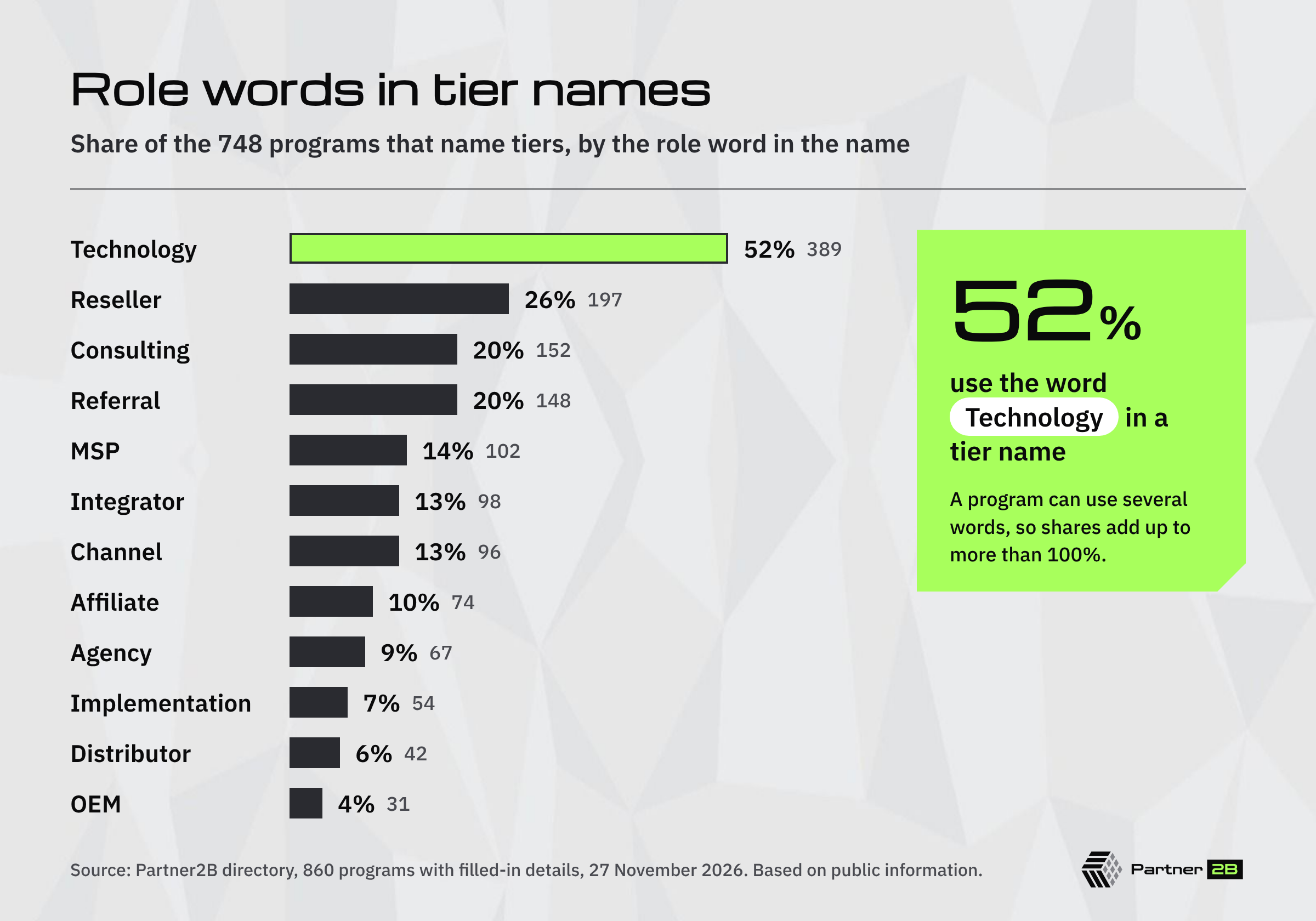
The word Technology appears in the tier names of 52% of programs that name tiers (389 programs). Reseller is next at 26%. Consulting and Referral are tied at 20%.
| Role word | Programs | Share | Usually means a partner who |
|---|---|---|---|
| Technology | 389 | 52% | builds an integration with the vendor's product |
| Reseller | 197 | 26% | buys from the vendor and sells to customers |
| Consulting | 152 | 20% | advises customers and recommends the product |
| Referral | 148 | 20% | introduces customers and is paid for it |
| MSP | 102 | 14% | runs the product for customers as a managed service |
| Integrator | 98 | 13% | connects the product to the customer's other systems |
| Channel | 96 | 13% | sells through indirect routes |
| Affiliate | 74 | 10% | promotes the product and earns per sign-up |
| Agency | 67 | 9% | uses the product in client work |
| Implementation | 54 | 7% | sets up and launches the product for customers |
| Distributor | 42 | 6% | buys in volume and supplies resellers |
| OEM | 31 | 4% | builds the product into its own offering |
A program can use several of these words, so the shares add up to more than 100%.
Level names: two families
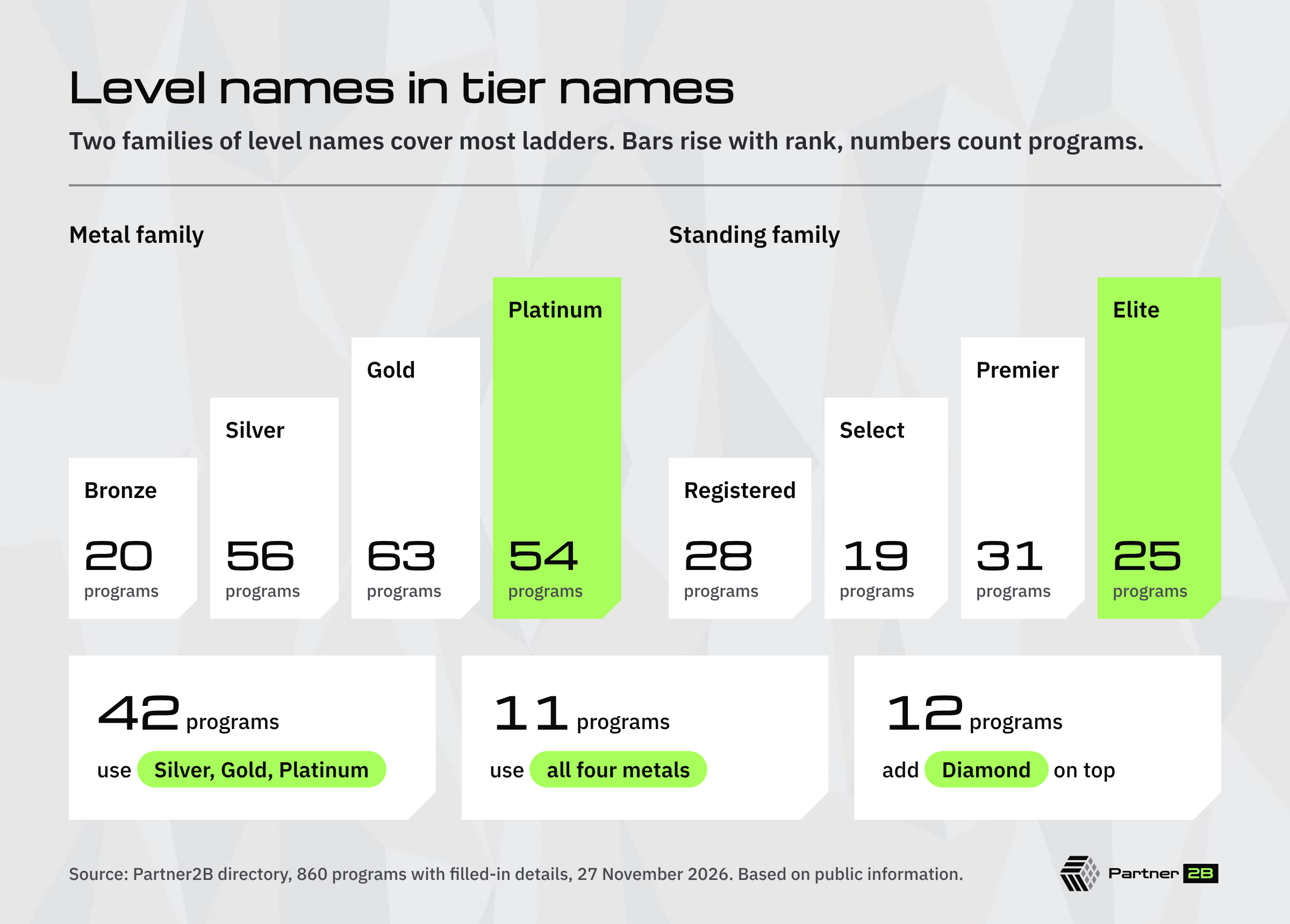
Level names come in two families. The metal family runs Bronze, Silver, Gold, Platinum. The standing family runs Registered, Select, Premier, Elite. Gold is the single most common level name, in 63 programs.
| Family | Names, low to high | Programs using each name |
|---|---|---|
| Metal | Bronze, Silver, Gold, Platinum, Diamond | 20, 56, 63, 54, 12 |
| Standing | Registered, Select, Premier, Elite | 28, 19, 31, 25 |
Silver, Gold and Platinum all appear together in 42 programs, and Bronze, Silver, Gold and Platinum together in 11.
Real tier names from named programs
| Program | Tier names | Kind |
|---|---|---|
| Xero | Partner, Bronze, Silver, Gold, Platinum | Levels, metal family |
| Snowflake | Registered, Select, Premier, Elite | Levels, standing family |
| Planful | Associate, Premier, Elite | Levels, standing family |
| NVIDIA | Registered, Preferred, Elite, plus partner types | Both |
| Stripe | Partner and Premier, across four tracks: Services, SaaS platforms, Apps, Payment methods | Both |
| Shufti | Referrals, Resellers, Affiliates | Roles |
The lesson is that there is a shared vocabulary. Partners already know what a Silver or a Premier tier means, and they already know what a Referral Partner does. Using the common words saves you a paragraph of explanation on every page.
Do programs with level names offer more to partners?
They tend to. Programs that rank partners by level are more likely to publish what partners earn (their commission model) and to fund their marketing.
| Fact | What it means |
|---|---|
| 62% of level-only programs publish a commission model, against 45% of role-only programs | A ladder only works if partners can see what moving up earns. Role-only programs often leave pay to a sales conversation. |
| 43% of level-only programs mention co-marketing funds, against 28% of role-only programs | Funding is a common reward for reaching a higher level. |
| 60% of level-only programs mention training, against 49% of role-only programs | Training is common in both groups and more common where levels exist. |
Deal registration shows a different pattern. It is almost the same in level-only (17%) and role-only (16%) programs, and it reaches 28% in programs that use both. The programs with a role track and a level ladder are the ones most likely to offer it.
Be careful with what this tells you. There are only 58 programs in the level-only group, and a level ladder does not cause a better program. The more likely explanation is that programs that invest in a ladder also invest in the rest. The practical point is simpler: if you add levels, partners will expect to see what each level gets.
How many tiers should your program have?
Here is the order I follow when I help a company design this.
- Start with partner types, not levels. Write down every way a partner can work with you: refer, resell, integrate, implement, advise. Each way that needs different terms is one track. Most programs need two or three.
- Add levels only when you have something to give. A ladder needs two things: a reason for partners to move up, such as better margin, funds, leads or support, and a result you can measure, such as revenue, certified staff or active customers. Without both, levels are only labels.
- Start with two or three levels. Only 5% of programs list five or more tiers. Each extra level needs its own benefits, its own requirements and a person to manage it. You can add a level later. Removing one is harder, because partners have already earned it.
- Make the first step easy. The entry tier should be open to any partner that meets a simple standard, with a clear join page. Names such as Registered or Associate tell partners this is the starting point.
- Give each tier a benefit the one below does not have. In our spot check, one program described its top tier in the same words as its entry tier. A partner who reads that has no reason to climb.
- Say what each tier gets. Only 46% of programs publish how partners are paid. If you publish yours, you stand out. The commission data behind that figure is in B2B partner program commission rates in 2026.
How should you name your tiers?
Name tracks for what the partner does. Referral Partner, Reseller Partner and Technology Partner are plain words that partners already use and search for.
Name levels in an order people recognise. Silver, Gold and Platinum, or Registered, Select, Premier and Elite, tell a partner where they stand without an explanation. Pick one family and keep it.
Avoid clever names. A partner should be able to tell which tier is theirs in ten seconds. A name that needs a footnote costs you applications.
Use the same names everywhere. Your program page, your directory listings and your partner portal should all use the same tier names, because directories and AI assistants tend to repeat the names a program uses.
Method and limits
- The numbers are based on public information from the program pages listed in the Partner2B directory on 27 November 2026. They cover 860 programs with filled-in details. The directory lists 1,379 programs. The rest are still being completed and are left out of every figure. Of the 860, 748 name tiers or partner types.
- Every listing is marked "not verified". Read the numbers as "based on public information", not as confirmed facts.
- The directory records tiers and partner types as each program names them, so levels and tracks are mixed in one field. The split into role names and level names is a keyword match on those names, and it is approximate.
- Spot check: we compared the listed tier names of 30 randomly chosen programs with their own program pages. Fifteen matched. Eleven matched in part, because a name was worded differently or one entry was missing or added. Three did not match, or the page had moved. One site could not be reached. Treat each count as approximate.
- Programs change their structure. The numbers describe the pages on the date above.
- The level-only group has 58 programs, so comparisons with it show a link, not a cause.
- Shares are of the programs in the directory, not of all partner programs in the market.
We will refresh these numbers as more programs are completed.
FAQ
How many tiers should a partner program have?
Two or three is the best start. Of the 860 programs we compared, 42% list three tiers and 59% list three or four. Begin with the partner types you need, and add levels once partners have a reason to move up.
What are typical partner program tier names?
For roles: Technology Partner, Referral Partner, Reseller Partner, Consulting Partner and Integration Partner. For levels: Silver, Gold and Platinum, or Registered, Select, Premier and Elite.
What is the difference between a tier and a partner type?
A partner type, or track, says what the partner does, such as refer, resell or integrate. A tier, or level, says how far the partner has progressed. A program can have both. Stripe has two tiers across four tracks.
Do I need Silver, Gold and Platinum levels?
No. Among programs that name tiers, 77% use role names only. Add levels when you can name a reward for each step and a result you can measure.
How many tiers do large programs have?
Most large programs list three or four. NVIDIA, for example, has three membership levels and a long list of partner types. A very long list of tiers is rare.
What to do next
If you are designing a program, the Program builder helps you set your partner types and first tiers. To see how other programs name and structure theirs, browse the directory and open any listing. If partners sign up and then go quiet, read why partners go quiet after signing.