
TL;DR: Most B2B companies fail at partnerships not because of poor strategy but because of structural gaps. This article covers the six-step Partner-Led Growth Framework that turns partnerships into a real GTM motion, including how to build the foundation, recruit the right partners, define activation, and distribute ownership across functions.
What Is Partner-Led Growth?
Partner-led growth is a go-to-market model where partnerships, including technology partners, reseller partners, and channel partners, function as a primary revenue motion alongside direct sales and marketing. Rather than treating partnerships as a supplementary channel, partner-led growth embeds them into GTM strategy from the start, with defined metrics, cross-functional ownership, and infrastructure that scales.
What Is a GTM Partnership Strategy?
A GTM partnership strategy is the deliberate integration of partner relationships into how a company reaches, converts, and retains its ideal customers. It includes partner program design, partner recruitment based on ICP trust mapping, activation metrics, and co-ownership across marketing, sales, and product teams.
Why Partnerships Keep Getting Deprioritized
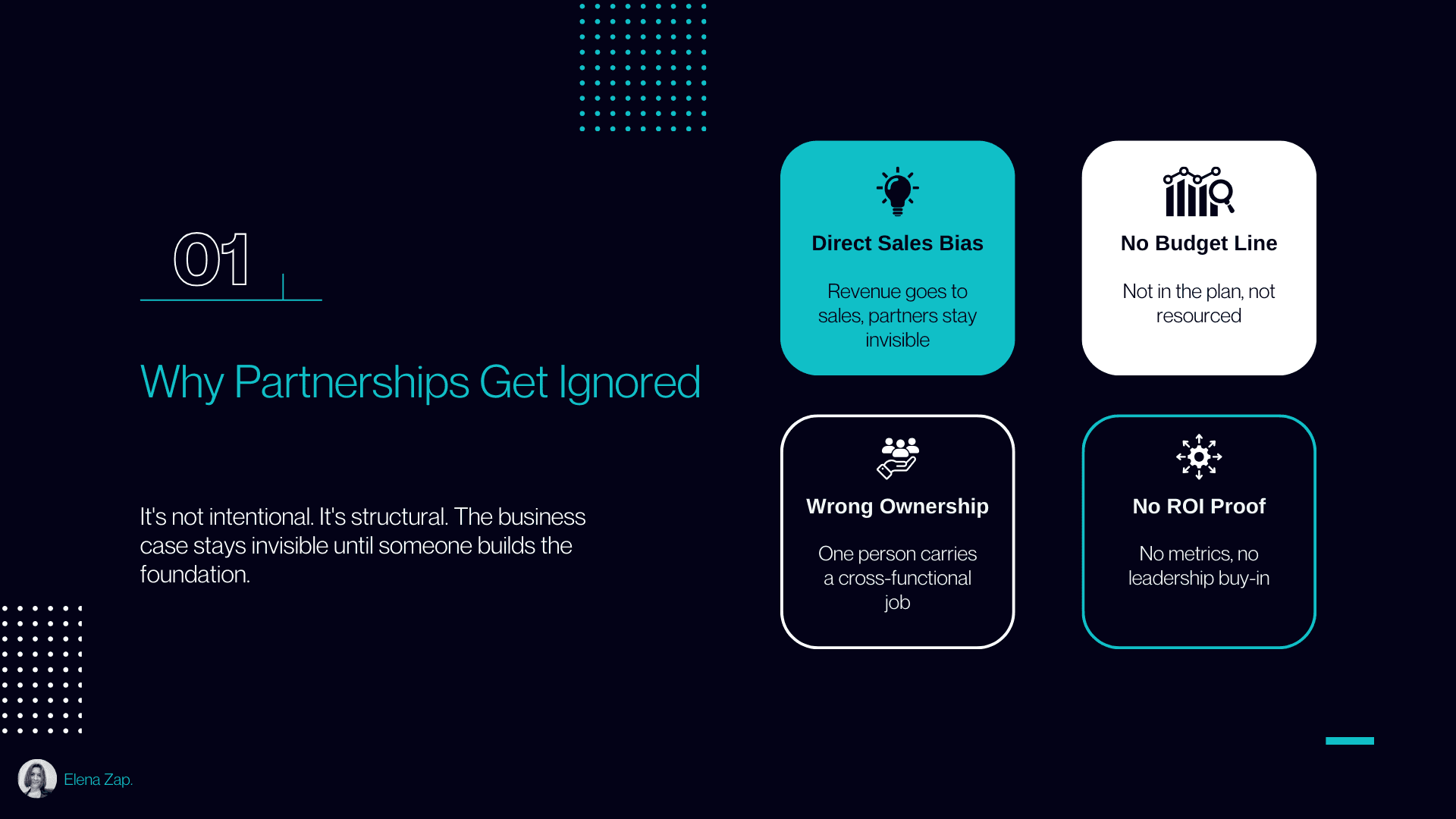
Ask any partnerships leader why their program is underfunded and understaffed, and you will hear a version of the same story. Leadership says they believe in partnerships. The budget does not reflect that belief. The headcount does not either. And the metrics that would prove partnerships are working have never been set up.
The problem is not belief. It is structure.
Four structural failures cause partnerships to stall inside otherwise well-run B2B companies.
Direct sales bias. Revenue attribution flows to whoever closes the deal. When a reseller partner or technology partner influences a sale, that influence rarely shows up in a dashboard. Sales takes credit, and the partnership contribution stays invisible. Over time, invisible contribution equals no budget, no headcount, and no program.
No budget line. Partnerships that are not planned for do not get funded. This plays out in a specific way: partnerships get added to someone's existing job description rather than receiving dedicated resources. The work gets done partially, results are underwhelming, and the conclusion drawn is that partnerships do not work, when the real conclusion should be that underfunded programs do not work.
Wrong ownership model. Partnerships is a cross-functional role by definition. It touches demand generation, product integrations, sales enablement, and customer success simultaneously. Assigning it to one person without cross-functional authority is a setup for failure. One person cannot carry a cross-functional motion alone.
No ROI proof. Without defined metrics, there is no business case. Without a business case, there is no leadership buy-in. Without leadership buy-in, no one defines metrics. The cycle repeats indefinitely. The only exit is building the measurement infrastructure before you need it to justify the program.
These four failures reinforce each other. Breaking the cycle requires addressing all of them through deliberate program design, not just hiring a partnerships manager and hoping for results.
The Partner-Led Growth Framework: 6 Steps
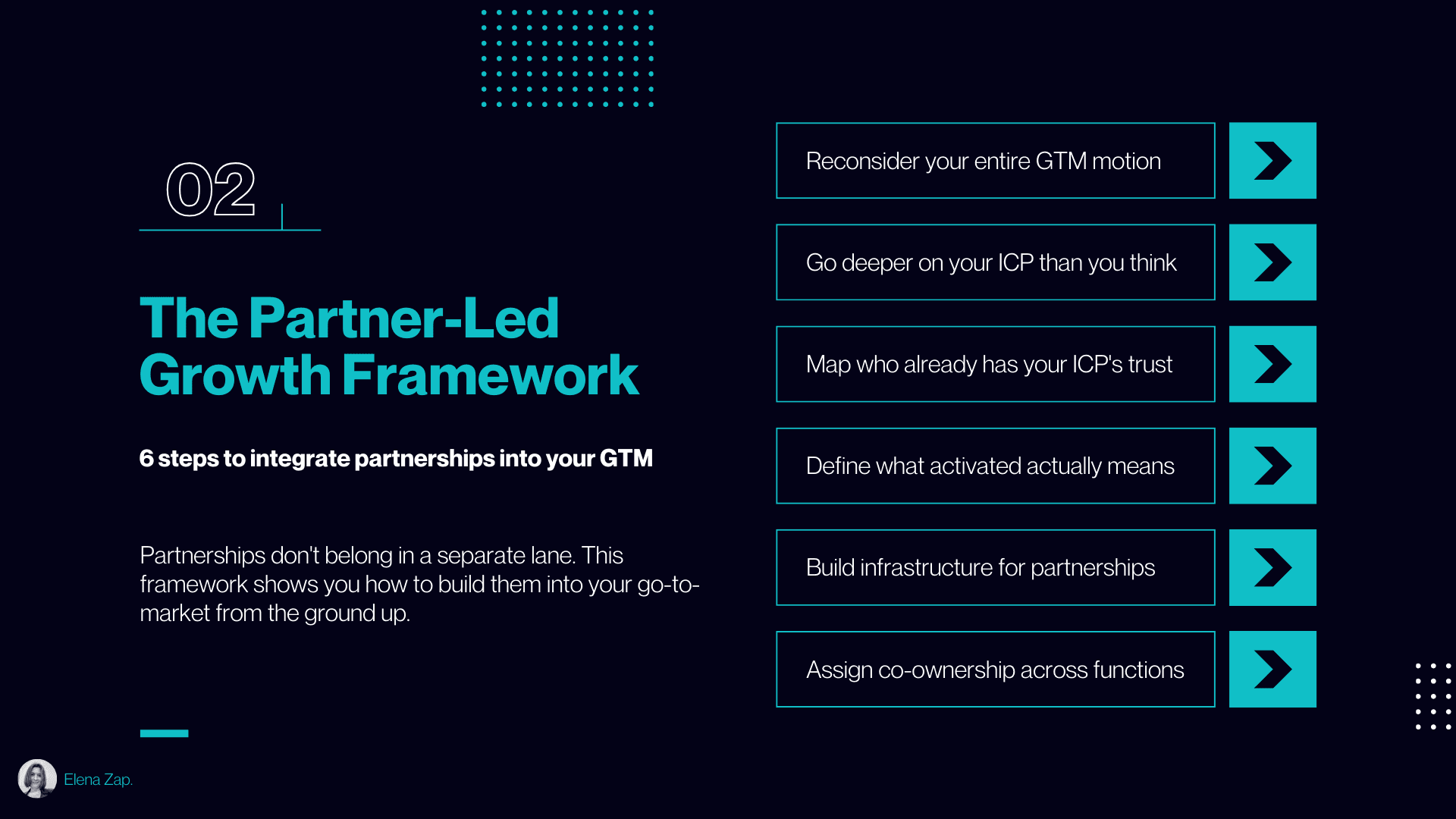
Partnerships do not belong in a separate lane from your go-to-market. They belong inside it, built in from the start, weighted alongside direct sales and marketing as an equal revenue motion.
The Partner-Led Growth Framework consists of six steps. The first three build the foundation before you recruit a single partner. The second three activate that foundation into a functioning GTM motion. Companies that skip the foundation and go straight to recruitment end up with large partner lists and no partner revenue.
Step | Action | Phase |
|---|---|---|
01 | Reconsider your entire GTM motion | Foundation |
02 | Go deeper on your ICP than you think | Foundation |
03 | Build infrastructure for partnerships | Foundation |
04 | Map who already has your ICP's trust | Activation |
05 | Define what activated actually means | Activation |
06 | Assign cross-functional ownership | Activation |
Phase One: Build the Foundation First
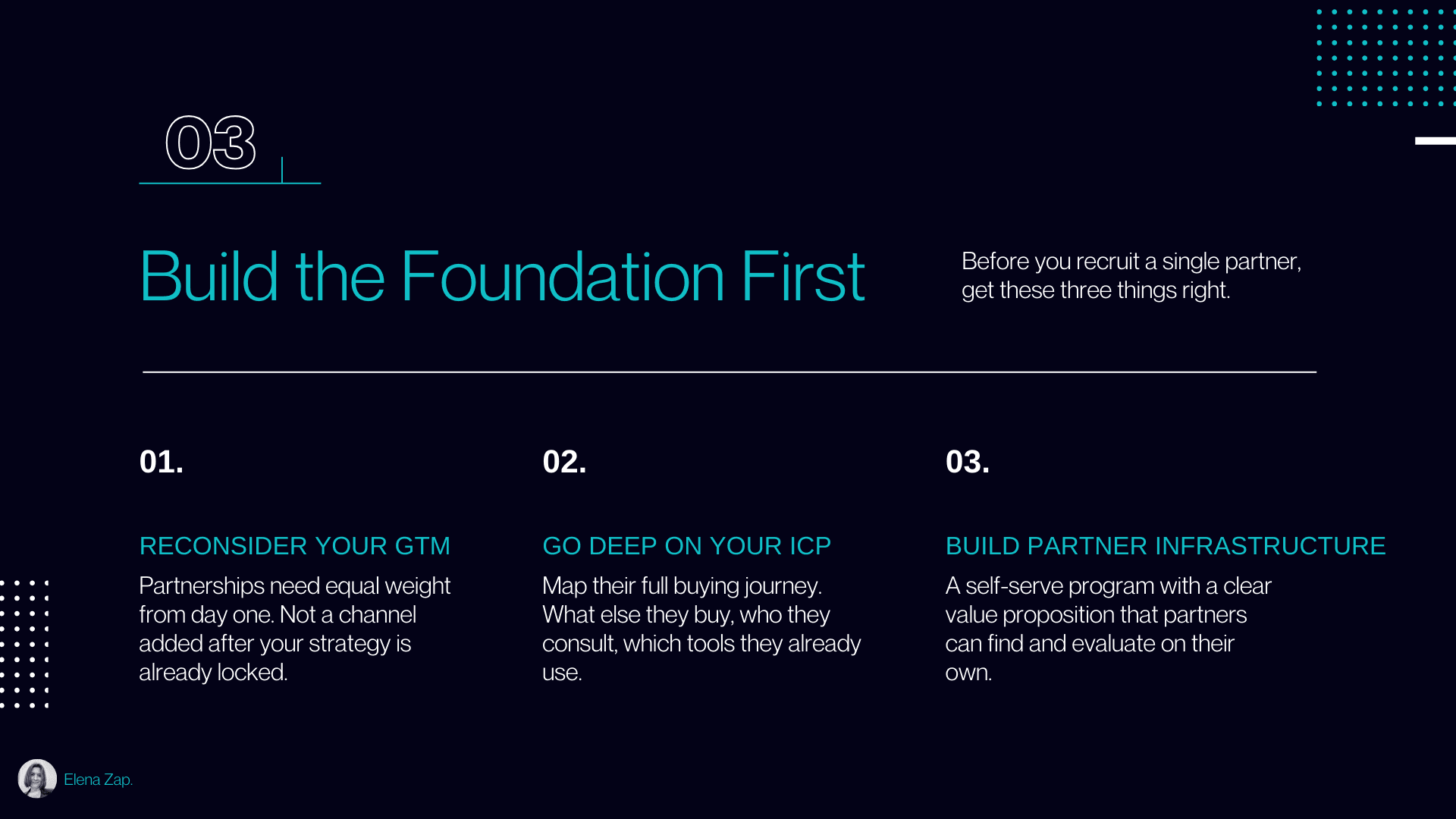
Before outreach, before recruitment, before partner agreements, three things need to be in place. Skipping any one of them makes the other two far less effective.
Step 1: Reconsider your entire GTM motion
The most common partnerships mistake is treating it as a channel you add after your strategy is already locked. Leadership agrees on the direct sales plan, marketing sets the demand gen budget, product finalizes the roadmap, and then someone asks whether partnerships should be part of the mix. At that point, partnerships is retrofitted into a plan that was not designed to accommodate it.
Partnerships need to be in the room when GTM strategy is being set. That means asking, from the start, which segments are better reached through partners than through direct sales. Which product integrations would accelerate ICP adoption. Which channel partner types already have relationships with the buyers you are trying to reach. These are strategy questions, not execution questions, and they need to be answered at the strategy level.
Step 2: Go deeper on your ICP than you think
Most B2B companies have an ICP definition that covers industry, company size, and job title. That is the starting point, not the full picture. For partnerships to work, you need to understand the full buying context of your ideal customer.
What else does your ICP buy alongside your product? Who do they consult when evaluating solutions in your category? Which tools are already embedded in their workflow? Which vendors do they trust? These questions reveal the partner landscape that already exists around your buyers. Your future partners live in that ecosystem. They are already earning the trust you are trying to build.
Step 3: Build partner infrastructure
A partner program that exists only as a PDF and a commission structure is not a program. It is a document. Real partner infrastructure means a self-serve experience that a potential partner can find, evaluate, and act on without needing a meeting with your team.
This includes a discoverable partner program listing, a clear value proposition for partners, defined tiers and requirements, onboarding materials, and a way for partners to track their activity and results. The infrastructure has to work before you start recruiting, because the quality of your infrastructure signals the quality of your commitment.
Getting your partner program listed and discoverable on a platform like Partner2B is part of building this infrastructure. If potential partners cannot find your program when they are actively searching for partnership opportunities, the program does not functionally exist for them.
Phase Two: Then Make It Work
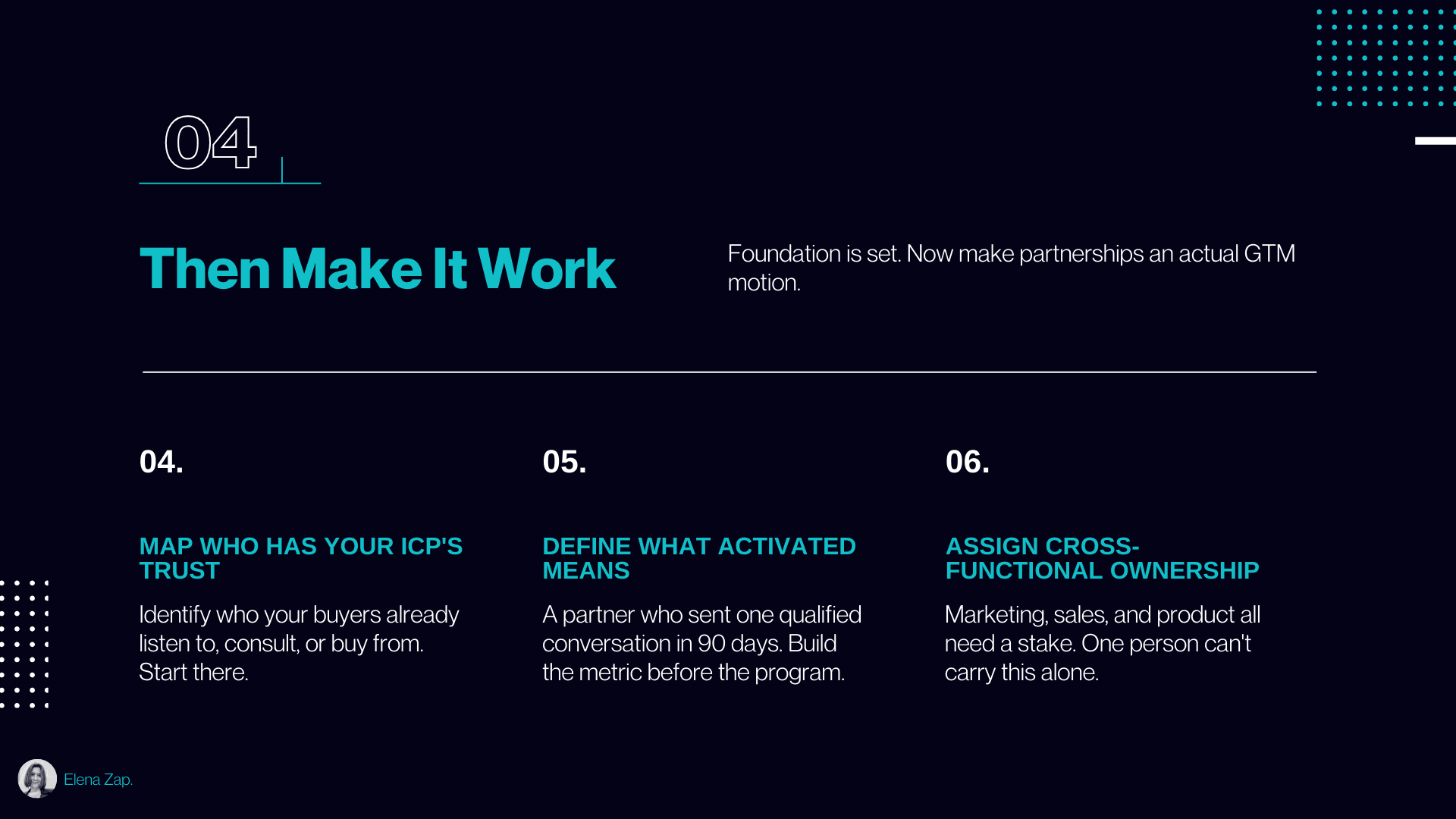
Foundation is set. Now the work shifts from building to activating. Steps four through six transform a well-designed program into a GTM motion that generates pipeline.
Step 4: Map who already has your ICP's trust
This is the most underutilized step in partner recruitment. Most companies recruit partners based on audience size or product adjacency. The better filter is trust.
Who does your ICP already listen to when making buying decisions? Which vendors are already embedded in their workflow? Which consultants do they hire when they have a problem your product solves? Start with the partners who have already earned trust with your ICP, because a referral from a trusted source converts at a fundamentally different rate than a referral from a partner your buyer has never heard of.
Technology partners, reseller partners, and channel partners who already operate inside your ICP's world are your highest-value recruitment targets.
Step 5: Define what activated actually means
This is the step most programs skip, and skipping it is why most programs cannot demonstrate ROI. Before you launch a partner program, define what an active partner looks like in concrete, measurable terms.
A useful benchmark: a partner who delivers one qualified conversation within 90 days of joining. Not a signed agreement. Not a completed onboarding. A qualified conversation with a prospect who fits your ICP and has expressed genuine interest.
That definition creates accountability in both directions. It tells partners what success looks like. It gives your team a clear signal for which partnerships are performing. And it gives leadership a metric they can evaluate without needing to be educated on partnership dynamics. Build the metric before you build the program.
Step 6: Assign cross-functional ownership
Partnerships cannot be owned by one person. This is not a resourcing argument, it is a structural one. A program that touches only the partnerships team will always underperform a program where marketing, sales, and product each have a defined stake in partner success.
Marketing owns co-marketing with partners and integrating partner-sourced leads into nurture flows. Sales owns partner referral follow-up speed and the quality of introductions they make. Product owns the integration roadmap and technical enablement. The partnerships lead coordinates all of this and holds the relationships, but cannot execute it alone.
Cross-functional ownership also solves the ROI visibility problem. When sales sees partner-sourced pipeline in their numbers, they have a reason to invest in making partnerships work. Shared ownership creates shared incentive.
The Window Is Now
2026 is not another year to evaluate whether partnerships are worth investing in. It is the year when companies that built the foundation will start pulling ahead in ways that are genuinely difficult for competitors to close.
Partner ecosystems compound. A company with two years of active partner relationships, strong program infrastructure, and a discoverable, well-positioned program in the market has built something that takes years to replicate. Trust cannot be shortcut. Partner relationships cannot be copied from a competitor's playbook.
The structural advantages of partner-led growth, including lower cost of acquisition through warm referrals, expanded reach into markets direct sales cannot efficiently cover, and compounding ecosystem credibility, are available now to companies willing to build the foundation correctly.
Discovery is where partner relationships begin. Infrastructure is how they scale. Partner2B exists to connect companies that are ready to grow through partnerships with the programs actively looking for partners like them.
Frequently Asked Questions
What is the difference between partner-led growth and affiliate marketing?
Partner-led growth involves real business relationships with technology partners, reseller partners, and channel partners who actively co-sell, integrate, or refer within a defined program structure. Affiliate marketing is a performance-based model focused on commission-driven referral links, typically without the strategic alignment, joint enablement, or co-selling that characterize B2B partner programs.
How do you measure partnership ROI?
Partnership ROI is measured through partner-sourced pipeline, partner-influenced revenue, activation rate (the percentage of recruited partners who deliver at least one qualified referral within a defined period), and cost of partner-acquired customers compared to direct sales acquisition costs. The foundation for measurement is defining activation metrics before the program launches.
What does an activated partner mean?
An activated partner is one who has taken a defined revenue-generating action within a set timeframe. A practical benchmark is a partner who delivers one qualified conversation within 90 days of joining the program. Activation rates are one of the clearest indicators of whether a partner program is functioning or simply accumulating signed agreements with no output.
When should a B2B company start building a partner program?
The right time to build a partner program is once a company has proven product-market fit and has a clear ICP definition. Building partner infrastructure before those two conditions are met results in partners who cannot position the product accurately and prospects who are not the right fit. After product-market fit, the six-step framework applies directly.
What is the most common reason B2B partner programs fail?
The most common reason is structural, not strategic. Programs fail because of direct sales bias in attribution, no dedicated budget, single-person ownership of a cross-functional role, and the absence of defined activation metrics. These four failures compound each other and can only be resolved through deliberate program design rather than incremental fixes.
What is a reseller partner in B2B?
A reseller partner is a company that sells your product to end customers, typically under their own commercial relationship, often bundled with their own services or complementary products. Reseller partners are distinct from referral partners in that they take commercial ownership of the sale rather than simply introducing the prospect.
How is partner-led growth different from product-led growth?
Product-led growth uses the product itself as the primary acquisition and expansion mechanism, typically through free trials, freemium models, or viral in-product features. Partner-led growth uses third-party relationships, including technology integrations, resellers, and channel partners, as the primary acquisition and expansion mechanism. The two can and often do coexist within the same GTM strategy.
What to Do Next
If you run a B2B partner program or are building one, the practical starting point is making your program findable. The companies and resellers actively searching for partnerships in your category are looking right now. If your program is not discoverable, those conversations start with someone else.
From there, the framework applies directly: audit your GTM to give partnerships equal weight, map your ICP buying context, build self-serve program infrastructure, recruit based on trust, define activation metrics before you recruit, and distribute ownership across functions.
Partnerships built this way become competitive infrastructure. The ones built without this foundation stay invisible, underfunded, and easy to deprioritize until someone finally builds what was always possible.