
Introduction: Why Partner Value Proposition Determines Ecosystem Success
In today's ecosystem-led B2B landscape, growth is no longer achieved through direct sales alone. Strategic partnerships have become a major revenue driver, with 58% of revenue for top-performing companies now coming from partners. However, attracting and keeping the best partners requires more than just offering a good product.
It requires a compelling Partner Value Proposition (PVP): a clear, powerful statement that shows partners why working with you is the smartest move for their business growth, not just yours.
In this comprehensive guide, you'll learn how to craft a partner value proposition that attracts top-tier partners, boosts your ecosystem influence, drives sustainable revenue, and creates genuine mutual value that keeps partners engaged long-term.
What Is a Partner Value Proposition?
A partner value proposition (PVP) defines how a partnership with your company benefits the partner's business, not just your own. It is designed to answer the partner's core questions from their perspective, not yours.
The Critical Partner Questions
Will this help me grow faster? Partners evaluate whether your program accelerates their revenue growth, expands their market reach, or increases their customer base more effectively than alternative uses of their time and resources.
Will this help me serve my customers better? Partners assess whether your solutions, support, and collaboration enable them to deliver superior customer outcomes, reduce implementation risk, or expand service offerings.
Will this partnership improve my profitability, brand, or competitive position? Partners determine whether the economics are attractive, whether association with your brand strengthens their position, and whether the partnership provides competitive differentiation.
How PVP Differs from Customer Value Proposition
Unlike a customer value proposition focused on product features, pricing, and end-user benefits, a PVP focuses on business-to-business value creation between companies.
Customer value proposition focuses on:
Product features and functionality
User experience and ease of use
Price and total cost of ownership
Direct customer outcomes and ROI
Partner value proposition focuses on:
Partner revenue and margin opportunity
Market expansion and customer access
Competitive differentiation and brand leverage
Operational efficiency and ease of doing business
Strategic alignment and long-term growth potential
The fundamental difference: customer value propositions sell products; partner value propositions sell business growth opportunities.
Why a Strong PVP Matters: The Competitive Context
The data demonstrates the strategic importance of partnerships, but also reveals the competitive intensity for high-quality partners.
Partnership Performance Data
Revenue contribution: 58% of revenue for top-performing companies now comes from partners, indicating that partnerships are not supplementary but central to growth strategies
Sales efficiency: 53% of partner-involved deals close faster, reducing sales cycles and improving capital efficiency
Customer acquisition economics: 72% of businesses find customer acquisition costs lower through partners compared to direct channels
Deal value: Deals with partners have 40% higher average order value than those without partner involvement
The Partner Competition Reality
While partnership benefits are clear, competition for valuable partners is fierce. Top-performing partners have multiple options, receive constant recruitment from competitors, and carefully evaluate which programs deserve their limited time and resources.
Why partners are selective:
Top partners have finite capacity and must prioritize highest-ROI opportunities
Poor partnerships drain resources without delivering promised value
Switching costs exist once partners invest in enablement, training, and customer development
Reputation risk exists if they recommend solutions that underperform
Without a differentiated, partner-centric PVP, your company risks being overlooked, deprioritized, or losing partners to competitors with more compelling programs. A strong PVP is what makes partners prioritize working with you over competing opportunities.
Key Ingredients of a Winning Partner Value Proposition
Effective PVPs address multiple dimensions of partner value. The most successful programs excel across all key factors rather than optimizing single dimensions.
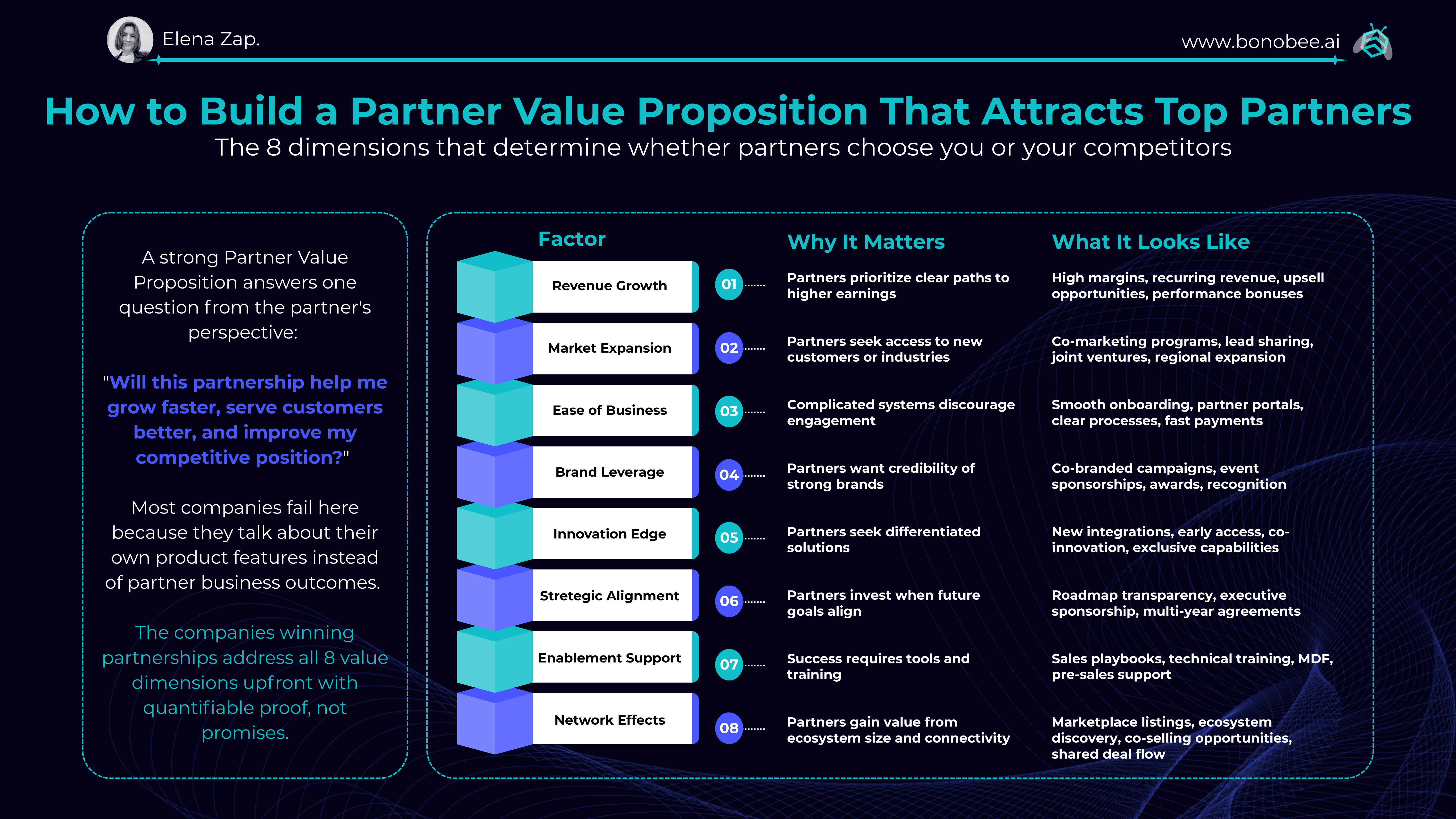
1. Revenue Growth Opportunity
Partners prioritize programs with clear, substantial paths to higher earnings. Revenue potential is typically the primary decision factor for most partner types.
What this includes:
Attractive margins or commission structures benchmarked competitively
Recurring revenue opportunities through subscription or renewal models
Upsell and cross-sell potential expanding deal value over time
Deal protection through deal registration preventing channel conflict
Performance bonuses or accelerators rewarding high achievement
Example messaging: "Partners in our program achieve 25-40% margins on initial sales plus 15% recurring commission on renewals, with top performers earning accelerators up to 50% on sales exceeding quarterly targets."
2. Market Expansion Access
Partners seek partnerships that open new customer segments, geographies, or industries they couldn't efficiently access independently.
What this includes:
Co-marketing programs amplifying partner reach
Lead sharing or referral programs providing qualified opportunities
Joint go-to-market initiatives for specific verticals or regions
Brand association enabling access to enterprise or regulated markets
Customer base access through ecosystem connections
Example messaging: "Access our 5,000+ enterprise customer base for cross-sell opportunities, plus dedicated co-marketing support including joint webinars, case studies, and event presence amplifying your reach in healthcare and financial services."
3. Ease of Doing Business
Complicated systems, slow processes, and administrative burdens discourage partner engagement regardless of revenue potential.
What this includes:
Smooth, structured onboarding reducing time-to-first-deal
Dedicated partner portals with self-service access to resources
Clear processes for deal registration, quote generation, and approval
Responsive partner support and dedicated partner managers
Automated commission tracking and fast payment processing
Example messaging: "Our streamlined partner portal provides one-click deal registration, automated quote generation, and transparent commission tracking with monthly payouts within 15 days of invoice payment."
4. Brand Leverage and Credibility
Partners value association with strong brands that enhance their market position and credibility with customers.
What this includes:
Co-branded marketing campaigns and collateral
Joint press releases and case study development
Event sponsorship and speaking opportunities
Partner awards and recognition programs
Logo usage rights and brand association
Example messaging: "Leverage our market-leading brand with co-branded presentations, joint customer success stories, and recognition in our annual Partner Excellence Awards program reaching 50,000+ industry decision-makers."
5. Innovation and Competitive Edge
Partners seek differentiated solutions that provide competitive advantages they can't obtain elsewhere.
What this includes:
Unique product capabilities or integrations
Early access to new features and products
Technology alliance opportunities for co-innovation
Exclusive territory or vertical rights for strategic partners
Product roadmap visibility and influence
Example messaging: "Strategic partners receive exclusive 90-day early access to new products, priority consideration for co-innovation projects, and quarterly product roadmap briefings with our product leadership team."
6. Long-Term Strategic Alignment
Partners invest more deeply when they believe the partnership has multi-year potential and strategic alignment.
What this includes:
Transparent product and company roadmap sharing
Executive sponsorship and relationship building
Multi-year partnership agreements for strategic partners
Shared vision for market evolution and growth
Partner advisory councils influencing strategic direction
Example messaging: "We invest in long-term partner success through multi-year agreements, executive business reviews with our C-suite, and Partner Advisory Council seats influencing our product roadmap and partnership strategy."
7. Comprehensive Enablement and Support
Partner success requires tools, training, resources, and ongoing support that enable effective selling and implementation.
What this includes:
Sales playbooks and methodology training
Technical certifications and implementation training
Competitive battlecards and objection handling guides
Market development funds (MDF) for demand generation
Pre-sales support and solutions engineering assistance
Marketing assets and campaign-in-a-box resources
Example messaging: "Partners receive comprehensive enablement including sales and technical certifications, dedicated solutions engineering support, up to $50K annual MDF allocations for qualified partners, and campaign-in-a-box resources requiring minimal customization."
Partner Value Proposition Framework
Factor | Why It Matters | What It Looks Like |
Revenue Growth | Partners prioritize clear paths to higher earnings | High margins, recurring revenue, upsell opportunities, performance bonuses |
Market Expansion | Partners seek access to new customers or industries | Co-marketing programs, lead sharing, joint ventures, regional expansion |
Ease of Business | Complicated systems discourage engagement | Smooth onboarding, partner portals, clear processes, fast payments |
Brand Leverage | Partners want credibility of strong brands | Co-branded campaigns, event sponsorships, awards, recognition |
Innovation Edge | Partners seek differentiated solutions | New integrations, early access, co-innovation, exclusive capabilities |
Strategic Alignment | Partners invest when future goals align | Roadmap transparency, executive sponsorship, multi-year agreements |
Enablement Support | Success requires tools and training | Sales playbooks, technical training, MDF, pre-sales support |
Related: The Best Places to Find B2B Partners (and What Most Platforms Get Wrong)
How to Build a Partner Value Proposition That Motivates Top Partners
Building a compelling PVP requires strategic thinking about partner needs, competitive differentiation, and tangible proof of value delivery.
Step 1: Define Your Ideal Partner Profiles
You cannot have a "one-size-fits-all" PVP. Different partner types have fundamentally different needs, business models, and value drivers. Start by defining your ideal partner profiles (IPPs) based on business models, verticals, regions, and solution fit.
Key Questions to Answer
Market strategy:
What industries or markets do we want to expand into?
Which geographies are strategic priorities?
What customer segments do we want to reach through partners?
Capability requirements:
What capabilities should our partners complement?
What technical expertise or certifications do partners need?
What sales and marketing sophistication is required?
Economic expectations:
What kind of revenue contribution do we expect from partners?
What investment can we make in partner support and enablement?
What margins or commissions can we offer competitively?
Strategic fit:
Do partners serve similar customer profiles (ICP overlap)?
Are GTM approaches compatible or complementary?
Do company values and cultures align?
Example Ideal Partner Profiles
Profile 1: Enterprise System Integrators
Large consulting firms (1,000+ employees)
Strong enterprise customer relationships
Technical capability for complex implementations
Healthcare and financial services expertise
Global delivery capability
Profile 2: Regional Resellers
Mid-sized companies (50-200 employees)
Deep market presence in specific geographies
SMB and mid-market customer focus
Sales-driven with basic technical capability
Value-added service offerings
Profile 3: Technology Alliance Partners
SaaS companies with complementary solutions
Similar target customer profiles
API integration capability
Co-marketing sophistication
Strategic alignment on market direction
Each profile requires tailored PVP emphasizing different value dimensions.
Step 2: Map the Mutual Growth Opportunity
Your PVP should clearly articulate how the partner grows by collaborating with you, not just how you grow. Frame value propositions around mutual opportunity.
Partner Growth Dimensions
Revenue increase:
Direct revenue from margins or commissions
Recurring revenue from renewals or subscriptions
Upsell and expansion opportunities
Performance bonuses and accelerators
Market access:
New customer segments or industries
Geographic expansion opportunities
Ecosystem connections and introductions
Brand association enabling enterprise access
Customer success improvements:
Better implementation success rates
Expanded solution capabilities through integrations
Improved customer satisfaction and retention
Reduced support burden through vendor resources
Product and service differentiation:
Unique capabilities not available from competitors
Innovation and co-development opportunities
Early access to new products and features
Exclusive rights or territories
Operational efficiency:
Streamlined sales and delivery processes
Marketing automation and campaign support
Training and certification reducing learning curves
Tools and resources reducing administrative overhead
Strategic positioning:
Brand enhancement through association
Competitive differentiation
Thought leadership and market recognition
Industry awards and validation
Frame your PVP around these mutual growth opportunities with specific, quantifiable examples of how partners realize each benefit.
Step 3: Differentiate with Tangible, Quantifiable Advantages
Top partners evaluate multiple partnership opportunities simultaneously. Generic promises won't resonate. You must highlight unique, quantifiable advantages that set you apart from competing programs.
Differentiation Strategies
Quantify everything possible:
"Increase annual recurring revenue by 30% with co-branded SaaS bundles" (not "grow revenue")
"Partners average 2.5x higher win rates with our co-sell support" (not "improve win rates")
"Tap into $3B healthcare vertical demand through our dedicated channel programs" (not "expand market reach")
Emphasize unique advantages:
Exclusive capabilities competitors don't offer
Proprietary methodologies or frameworks
Market-leading brand recognition
Unique ecosystem connections
Exceptional support or enablement
Create competitive comparisons:
How your margins compare to competitors
How your support exceeds industry standards
How your brand provides unique advantages
How your technology enables differentiation
Provide specific examples:
"Access exclusive early product releases 90 days before general availability to gain competitive edge"
"Dedicated partner success managers for all Gold tier partners, with average <2 hour response time"
"$50K annual MDF allocation per qualified partner, 2x industry average"
Step 4: Prove Value with Metrics and Success Stories
Don't just promise value. Prove it with real-world evidence showing how your partners have succeeded.
Types of Proof Points
Quantitative partner results:
"Since joining our partner program, XYZ Tech increased their deal size by 22% and reduced sales cycles by 18%"
"Our top partners achieved a 2.5x higher win rate with co-sell initiatives compared to selling alone"
"Partners report 40% reduction in time-to-first-deal after our structured onboarding program"
Partner testimonials:
Direct quotes from partner executives about program value
Video testimonials from successful partners
Case studies detailing partner journey and results
Program performance metrics:
Average partner revenue contribution
Partner satisfaction scores (NPS)
Partner retention rates
Growth rates of partner-sourced revenue
Comparative benchmarks:
How your program performs vs. industry averages
How partner economics compare to direct sales
How partner growth rates compare to non-partners
Evidence-based PVPs convert at significantly higher rates than promises alone because they reduce perceived risk and prove the value proposition is real, not aspirational.
Step 5: Make It Visual and Easy to Digest
Busy partner executives won't read ten-page decks or lengthy website copy. Deliver your partner value proposition in clear, visual, scannable formats.
Effective PVP Formats
One-page partner value map:
Visual representation of all key benefits
Icons and graphics for quick scanning
Minimal text with maximum clarity
Clear call-to-action
Tiered benefits table:
Side-by-side comparison of partner tiers
Clear progression path from entry to top tier
Quantified benefits at each level
Requirements and commitments for each tier
Infographics showing growth paths:
Visual journey from onboarding to maturity
Expected milestones and timelines
Revenue potential at each stage
Support and resources available
Interactive partner portal:
Self-service exploration of benefits
Personalized value calculators
Video explainers and demos
Direct application or inquiry path
First impressions matter tremendously. Visual clarity and ease of comprehension equal credibility and professionalism.
Real-World Examples: Partner Value Propositions That Work
Examining successful partner programs reveals common patterns and best practices in PVP design.
Salesforce: Ecosystem Empowerment
Salesforce's PVP emphasizes ecosystem scale and opportunity.
Key PVP elements:
Access to massive customer base (150,000+ customers)
Co-marketing opportunities with industry-leading brand
Comprehensive enablement through Trailhead and certifications
AppExchange marketplace providing discoverability
Partner community creating network effects
Results: Salesforce's AppExchange ecosystem generated over $17 billion in partner revenue, demonstrating the power of ecosystem-scale PVP.
Why it works: Salesforce emphasizes market access (huge customer base), brand leverage (market leader), and enablement (Trailhead), addressing multiple PVP dimensions simultaneously.
HubSpot: Low-Friction Enablement
HubSpot's partner program highlights operational simplicity and comprehensive support.
Key PVP elements:
No-cost certifications reducing partner investment
Dedicated partner account managers for personalized support
Rich co-selling playbooks and resources
Recurring revenue through renewal commissions
Active partner community and peer learning
Partner economics: Partners can achieve up to 20% commission plus recurring revenue from customer renewals, creating long-term income streams.
Why it works: HubSpot removes friction (free certifications, dedicated support) while providing attractive economics (recurring revenue), making partner activation fast and rewarding.
AWS: Technical Depth and Scale
AWS focuses its PVP on technical excellence and massive market opportunity.
Key PVP elements:
Comprehensive technical training and certifications
Co-innovation projects and technical partnerships
AWS Marketplace visibility and distribution
Migration funding and incentive programs
Partner opportunity funds (POF) for co-marketing
Results: AWS credits 95% of its business to partners, proving the power of ecosystem-driven strategy at massive scale.
Why it works: AWS provides technical credibility (certifications), market access (marketplace, huge customer base), and financial support (migration funding, POF), appealing to technically sophisticated partners.
Tailoring Your PVP for Different Partner Types
Different partner types value different benefits. Customize your PVP based on partner archetypes to maximize relevance and appeal.
Partner Type Value Priorities
Partner Type | PVP Focus Areas | Key Success Factors |
Resellers | High margins, fast sales enablement, MDF programs, deal protection | Revenue opportunity, ease of selling, marketing support |
System Integrators | Complex solution support, certifications, project collaboration, professional services margins | Technical enablement, implementation support, services revenue |
Technology Alliances | Joint product development, technical validation, co-innovation, integration support | Strategic alignment, technical capability, co-marketing |
Referral Partners | Simplicity, fast payouts, minimal operational burden, high commissions | Easy process, attractive economics, quick payment |
Marketplace Partners | Visibility, revenue share models, cross-sell potential, marketplace support | Distribution reach, customer access, listing optimization |
Customization Examples
For resellers: "Earn 25-35% margins on all sales plus 5% ongoing commission on renewals. Access pre-built sales playbooks, competitive battlecards, and up to $25K annual MDF for demand generation. Deal registration protects your investment in opportunity development."
For system integrators: "Gain technical certification in our enterprise platform enabling complex implementations. Access dedicated solutions architecture support, implementation best practices, and professional services margins up to 40%. Join co-innovation projects with our product team."
For technology partners: "Integrate with our platform using comprehensive API documentation and sandbox environments. Co-market integrated solutions through joint webinars, content, and marketplace presence. Early access to product roadmap and beta features enables competitive differentiation."
For referral partners: "Earn 10-15% commission on qualified referrals with no implementation responsibility. Simple online referral form, transparent tracking, and payment within 30 days of customer activation. No ongoing support obligations."
How to Evolve Your Partner Value Proposition Over Time
Markets shift. Partner needs change. Competitive dynamics evolve. If your PVP stays static, it becomes obsolete and less compelling over time.
PVP Evolution Best Practices
Annual PVP reviews:
Assess competitive partner programs and benchmark benefits
Evaluate partner satisfaction and identify gaps
Review partner economics and adjust for market changes
Update messaging based on proven results and new capabilities
Regular partner feedback:
Survey partners quarterly on program satisfaction and needs
Conduct partner advisory council sessions gathering strategic input
Analyze partner churn and identify improvement opportunities
Track partner NPS and investigate detractor feedback
Alignment with business evolution:
Update PVP when launching new products or entering new markets
Adjust focus as company strategy shifts (e.g., enterprise vs. SMB focus)
Evolve partner types based on GTM priorities
Refresh messaging as brand and market position strengthen
Clear communication of changes:
Announce PVP updates through partner newsletters
Host webinars explaining new benefits and opportunities
Update partner portal content reflecting changes
Provide partner managers talking points for conversations
Adaptability signals strength. Partners want to grow with companies that evolve intelligently based on market feedback rather than maintaining static programs regardless of changing conditions.
First 90 Days: Partner Activation Checklist
Winning the partner commitment is only the start. Activation ensures partners experience the value you promised and begin generating results quickly.
Critical Activation Activities
Week 1-2: Foundation
Welcome email or call from partner manager
Partner portal access and orientation
Initial joint business planning discussion
Partnership agreement execution
System access provisioning (CRM, deal registration, etc.)
Week 3-6: Enablement
Sales methodology and product training completion
Technical certifications for relevant roles
Access to sales playbooks, battlecards, and resources
First marketing assets and co-branding setup
Introduction to support and pre-sales resources
Week 7-10: Go-to-Market Planning
Joint account identification and targeting
First co-marketing initiative launch
Deal pipeline development
Performance metrics and targets alignment
Regular check-in cadence establishment
Week 11-12: Optimization
First deal support and win analysis
90-day performance review
Challenges identification and resolution
Goals refinement for next quarter
Relationship depth assessment
Ongoing: Continuous Engagement
Monthly or quarterly business reviews
Regular training and product updates
Co-marketing campaign execution
Performance tracking and optimization
Relationship nurturing and expansion
Activation Success Metrics
Track these metrics to ensure activation delivers on your PVP promises:
Time to first deal (target: <90 days)
Training completion rates (target: >80%)
Partner satisfaction scores (target: >8/10)
Deal registration activity (target: 5+ registrations in 90 days)
Co-marketing participation (target: 1+ initiative in 90 days)
Early wins often predict long-term partner success. Intentional activation is crucial for proving PVP value and establishing productive partnership rhythms.
Related: The Partner-Led Growth Playbook: KPIs, Metrics, and Signals That Prove It's Working
Common Mistakes to Avoid
Understanding common PVP pitfalls helps you avoid them in your program design.
Critical PVP Mistakes
Product-centric instead of business-centric: Talking only about your product features and benefits, not business outcomes for partners. Partners don't care about your product capabilities. They care about how those capabilities help them grow revenue, access markets, or serve customers better.
Vague promises without proof: Offering generic claims without clear ROI projections, success metrics, or partner testimonials. Statements like "grow your business" or "expand your reach" without quantification lack credibility.
Operational complexity: Making it complicated for partners to engage, register deals, access resources, or get support. Complexity kills partner engagement regardless of economic attractiveness.
One-size-fits-all approach: Using identical PVP for all partner types despite fundamentally different business models and needs. Resellers, integrators, and technology partners require tailored value propositions.
Ignoring partner feedback: Failing to gather or act on partner input after onboarding. Partners disengage when their concerns go unaddressed or their suggestions are ignored.
Static, unchanging programs: Maintaining the same PVP regardless of market evolution, competitive pressure, or changing partner needs. Programs that don't evolve appear stagnant and uncommitted.
Overpromising and underdelivering: Making commitments in PVP that operational reality doesn't support. Nothing destroys partner trust faster than unmet promises about support, leads, or program benefits.
Making Your Partner Program Discoverable
Even the best partner value proposition fails if potential partners can't find your program when actively searching for partnership opportunities.
Partner Program Visibility
Discoverability challenge: Most partner programs suffer from visibility problems. Program information is buried on websites, doesn't rank for relevant searches, and isn't discoverable when companies actively seek partnerships.
Solution: Partner program directories. Platforms like Partner2B provide searchable hubs where companies actively looking for partnership opportunities can discover and evaluate programs. Listing your program increases visibility to motivated potential partners.
Visibility benefits:
Inbound partner interest from companies actively seeking opportunities
Higher-quality partners who self-qualify based on program details
Reduced partner recruitment costs compared to outbound-only approaches
Competitive positioning as programs with visibility appear more established
Making your compelling PVP discoverable when partners search for opportunities dramatically improves partner acquisition efficiency and quality.
Strategic Takeaway: Partnership Success Starts with Partner-Centric Mindset
The best partnerships aren't based on contracts. They're built on mutual value creation, shared vision, and proven support that helps partners achieve their business objectives.
A strong Partner Value Proposition is not about selling your company. It's about helping your partners grow their businesses faster, more profitably, and with greater confidence. The most successful partner programs obsess over partner success, not just their own growth targets.
Key Implementation Principles
Partner-first thinking: Design programs around partner needs, not just vendor convenience. Ask "How does this help our partners?" before "How does this help us?"
Quantified value: Provide specific, measurable value propositions backed by data and partner success stories rather than generic promises.
Continuous evolution: Regularly gather partner feedback, track satisfaction, and evolve programs based on changing needs and market conditions.
Operational excellence: Deliver on promises through responsive support, clear processes, and partner-friendly systems that make doing business easy.
Strategic transparency: Share roadmaps, provide visibility into company direction, and involve partners in strategic discussions to build long-term commitment.
At Partner2B, we help companies accelerate ecosystem growth by making partner programs discoverable to potential partners actively searching for partnership opportunities. When your compelling PVP meets motivated partners seeking what you offer, exceptional partnerships emerge.
Build smarter partnerships. Deliver better outcomes. Scale faster.
Continue Learning About Partner Programs
Ready to make your partner program discoverable? Partner2B helps companies attract qualified partners by making partner programs visible when companies are actively searching for partnership opportunities.